

Light falls across a wooden table. The camera moves slowly through the living room towards the terrace. In the background you hear the wind and the morning sounds of the neighbourhood.
Within a few seconds you begin to imagine what it would be like to wake up right here.
You don't yet know the size of the house or the number of rooms. Yet you already sense the atmosphere of the place.
That is where I see the power of a property's cinematic story.
In our July article 10 Ways AI Is Changing Property Sales we introduced what new technologies make possible. Today I want to show how we use these possibilities in our current work at Satori Visuals.
From visualisation to a cinematic experience
Every property has something that sets it apart.
It may be the architecture, the natural light, the view of the landscape or the lifestyle the place offers.
So we don't start with the question of what AI can generate. We ask what we want to convey to the viewer.
For a residential project, the main theme might be living close to nature. For a modern villa, it might be privacy, space and calm.

We shape the composition, camera movement, light and rhythm of the storytelling around that.
Today we can turn existing photographs and architectural visualisations into cinematic scenes that convey the atmosphere of future living before construction is even finished.
A static image becomes a visual story.
But not with a single click.
Realism that respects the architecture
In our current projects we focus closely on photographic realism, spatial depth and natural light.
But image quality is not only about details.
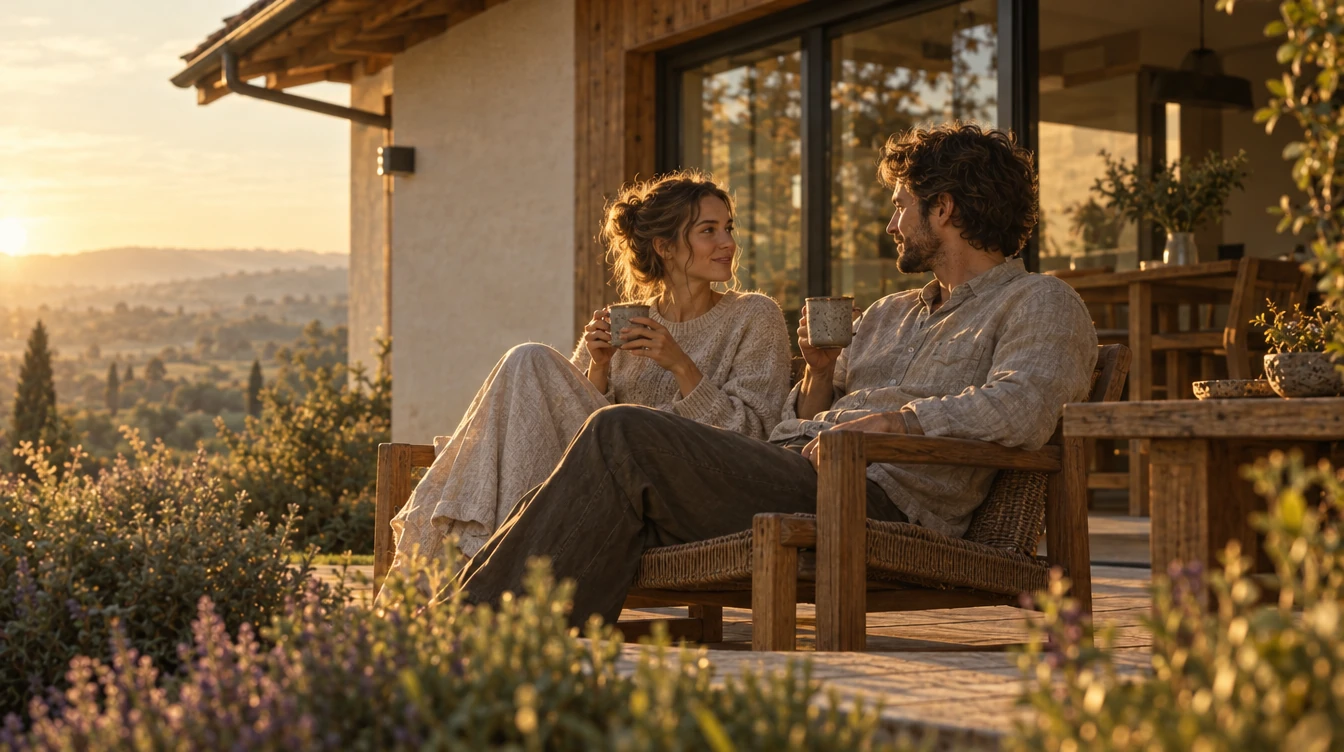
When the camera moves through an interior, the space must stay architecturally accurate. Room proportions, window positions, materials and views must match the original drawings and materials.
We approach digital characters the same way.
A couple over morning coffee or a family in the living room can help the viewer imagine life in the property. But their presence must feel natural and believable.
We treat digitally created scenes as a staged vision of possible life in the space, not as a documentary record of reality.
Our goal is not to create a prettier but untrue version of a property. We want to present its real or planned potential in a cinematic way.
Technology is a tool. People create the story.
More than 15 years of experience in film production have taught me that a convincing image doesn't come from simply using the right technology.
It comes from decisions.
What we show first. When we stay on a detail. How we cut to the next shot. Where we leave room for atmosphere, natural sound or a voiceover.
These principles stay the same in the age of artificial intelligence.
What changes are the creative possibilities.
For real estate agents and developers, this means existing materials can gain a new dimension. One project can have a main presentation film, short videos for social media and versions for international audiences.
Not every property needs a big cinematic story, though. Sometimes the best solution is a short, high-quality real estate video. Other times it makes sense to create a whole series of cinematic moments.
The character of the property and the purpose of the presentation decide.
A place that stays in your memory
At Satori Visuals we combine filmmaking craft with the possibilities of new technologies.
Not to create more images.
But to create images that mean something.
I want the viewer to remember a specific place after the video ends. Its light, its atmosphere and the moment they could imagine themselves there.
Because a good presentation doesn't just show a property. It helps us imagine life in it.
